What Does a Commercial HVAC System Actually Cost in Wisconsin?
Ballpark ranges, cost drivers, and a system-by-system breakdown — so you can budget with confidence before you ever pick up the phone.
If you've started asking around about commercial HVAC costs in Wisconsin, you've probably already gotten the most frustrating answer in contracting: "It depends." And while that's technically true, it's not particularly useful if you're trying to plan a budget, get board approval, or evaluate whether a contractor's number is in the right ballpark.
This guide is our attempt to be more helpful than that. We're going to give you real ranges — organized by system type — and walk you through the variables that pull those numbers up or down. Our goal isn't to sell you anything on this page. It's to make sure you walk into your next conversation with a contractor better informed than when you started.
We've been doing this work in Wisconsin since 1982. We know what systems cost. We also know that the price of getting it wrong — in downtime, energy waste, and premature equipment failure — almost always exceeds the cost of getting it right from the start.
Why Commercial HVAC Costs Vary So Much
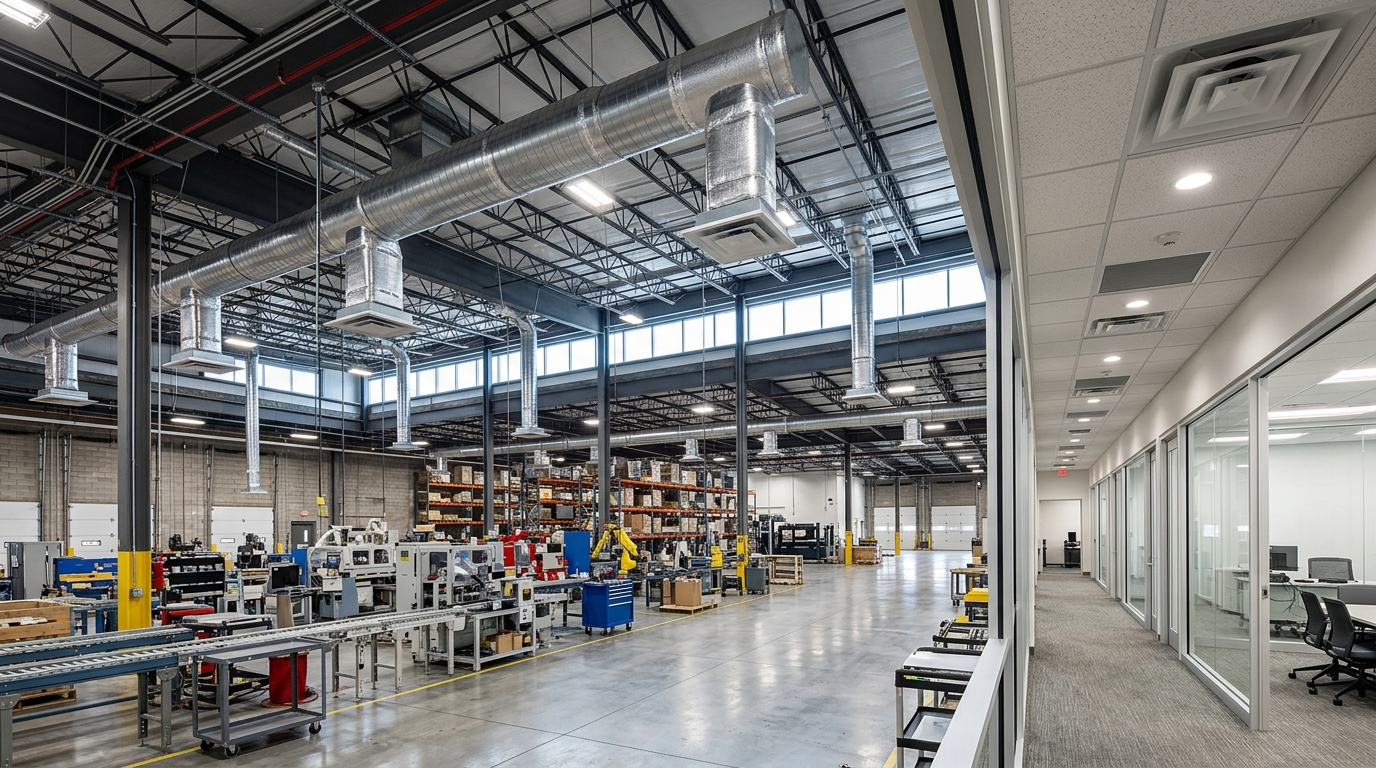
Commercial HVAC isn't a product with a price tag — it's a custom-engineered system built specifically for your building. A 10,000 sq ft office suite and a 10,000 sq ft manufacturing floor are physically the same size, but they may require entirely different equipment, ductwork configurations, ventilation strategies, and control systems.
A few things that immediately change the equation:
- Building type — Office, warehouse, manufacturing, food production, and healthcare all have different HVAC demands and code requirements.
- New construction vs. retrofit — Installing a system in a building under construction is significantly less expensive than retrofitting an existing occupied building.
- System complexity — A single-zone rooftop unit is far simpler (and cheaper) than a multi-zone VAV system with a BAS and hydronic reheat.
- Building envelope — Insulation quality, ceiling height, window-to-wall ratio, and building orientation all affect how hard your HVAC system has to work.
- Wisconsin climate — Our winters are real. Systems here need to be sized for genuine cold weather performance, not warm-climate averages.
A number without a scope isn't a quote — it's a guess. The ranges below are meant to orient your thinking, not replace a proper assessment.
Cost Breakdown by System Type
The table below reflects installed costs — equipment plus labor, standard ductwork, basic controls, and commissioning — for typical Wisconsin commercial projects. These are conceptual ballparks. Scope, site conditions, and complexity will move your actual number.
$8,000 – $25,000
Low
Small offices, retail, light commercial
Per unit installed. Simple duct layout, standalone controls. Cost rises with unit size and roof access difficulty.
$30,000 – $120,000
Medium
Mid-size offices, mixed commercial
Multiple rooftop units with zone dampers. Range depends heavily on number of zones and duct complexity.
Varies significantly
High
Large offices, multi-tenant, zoned facilities
Per-zone terminal units, BAS integration, air balancing. Zone count, building size, and duct complexity make this highly project-specific — best discussed directly with your contractor.
$15,000 – $60,000
Medium
Warehouses, manufacturing, high-exhaust spaces
Per unit. Interlocked with exhaust systems. Often required alongside primary HVAC for code-compliant ventilation.
$2,500 – $8,000
Low
Warehouses, shops, garages, docks
Per unit, including gas rough-in. An economical heating solution for open industrial spaces.
$15 – $30 per sq ft
High
Shop floors, manufacturing slabs, vehicle bays
PEX tubing, manifolds, boiler, and associated piping. Best installed during new construction. Exceptional comfort and efficiency long-term.
$20,000 – $80,000
Medium
Multi-story buildings, hydronic heating systems
Includes primary/secondary piping, pumps, expansion tank, and controls. Range scales with number of boilers and system complexity.
$3,000 – $9,000
Low
Server rooms, IT closets, supplemental zones
Per system. Common for IT rooms requiring dedicated 24/7 cooling independent of the main HVAC system.
$15,000 – varies widely
High
Any commercial facility with multiple systems
Controls integration, programming, sensors, remote access. Entry-level scopes start around $15,000. Larger facilities scale considerably higher. ROI through energy savings often justifies cost within 3–5 years.
Small single-zone commercial spaces with a single RTU can come in well under $50,000. Mid-size facilities — a 20,000–60,000 sq ft office or warehouse with multiple RTUs, VAV boxes, and controls — move into six-figure territory. Large industrial or multi-system facilities vary too widely to generalize. The honest answer: scope drives cost more than any other factor, which is why a conversation with your contractor is the only reliable path to a real number.
The 6 Biggest Factors That Drive Your Number Up or Down
Two facilities the same size can have HVAC costs that differ by 300%. Here's what moves the needle most:
Square footage is the obvious driver, but ceiling height matters just as much. High-bay warehouses require more powerful equipment and specialized air distribution to prevent stratification at occupant level.
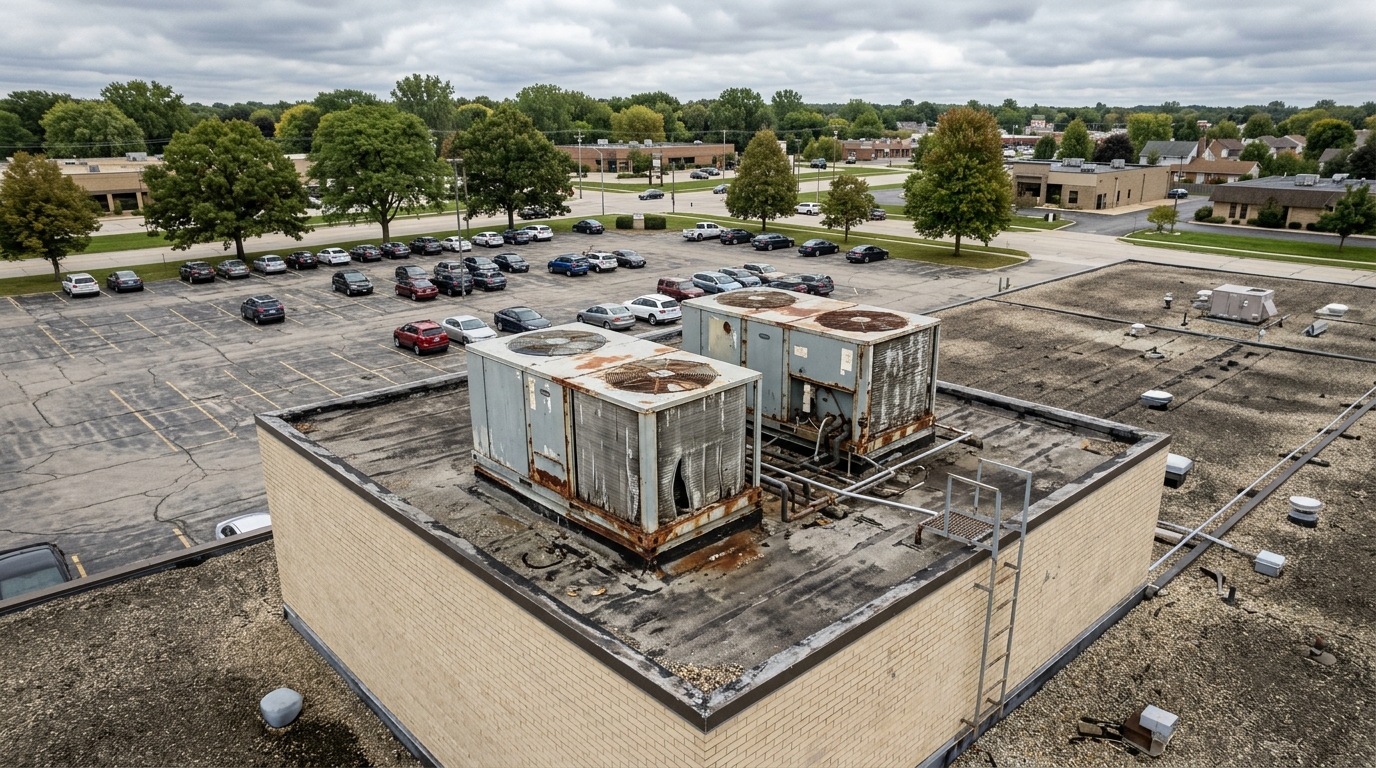
Retrofitting HVAC into an occupied, operational building typically adds 20–40% to project cost versus new construction. Coordination, sequencing, temporary systems, and access constraints all drive that number.
Every additional zone — a conference room, a server room, a production floor section — adds a VAV box, duct connections, controls wiring, and programming time. Zone count is a reliable proxy for total system complexity.
Manufacturing equipment, industrial processes, server infrastructure, and dense occupancy all generate heat that your HVAC system must overcome. High internal loads require larger, more robust equipment — and affect energy costs for the life of the building.
Wisconsin mechanical codes, ASHRAE standards, and industry-specific regulations (food production, healthcare, etc.) dictate minimum outside air, exhaust rates, and system design. Meeting code in specialized facilities adds real cost that can't be negotiated away.
Standalone thermostats are the cheapest option. A fully networked BAS with remote monitoring, alarm notifications, energy dashboards, and multi-system integration is the most expensive — and often the most cost-effective over a 10-year horizon.
What's Included in a Proper Commercial HVAC Installation
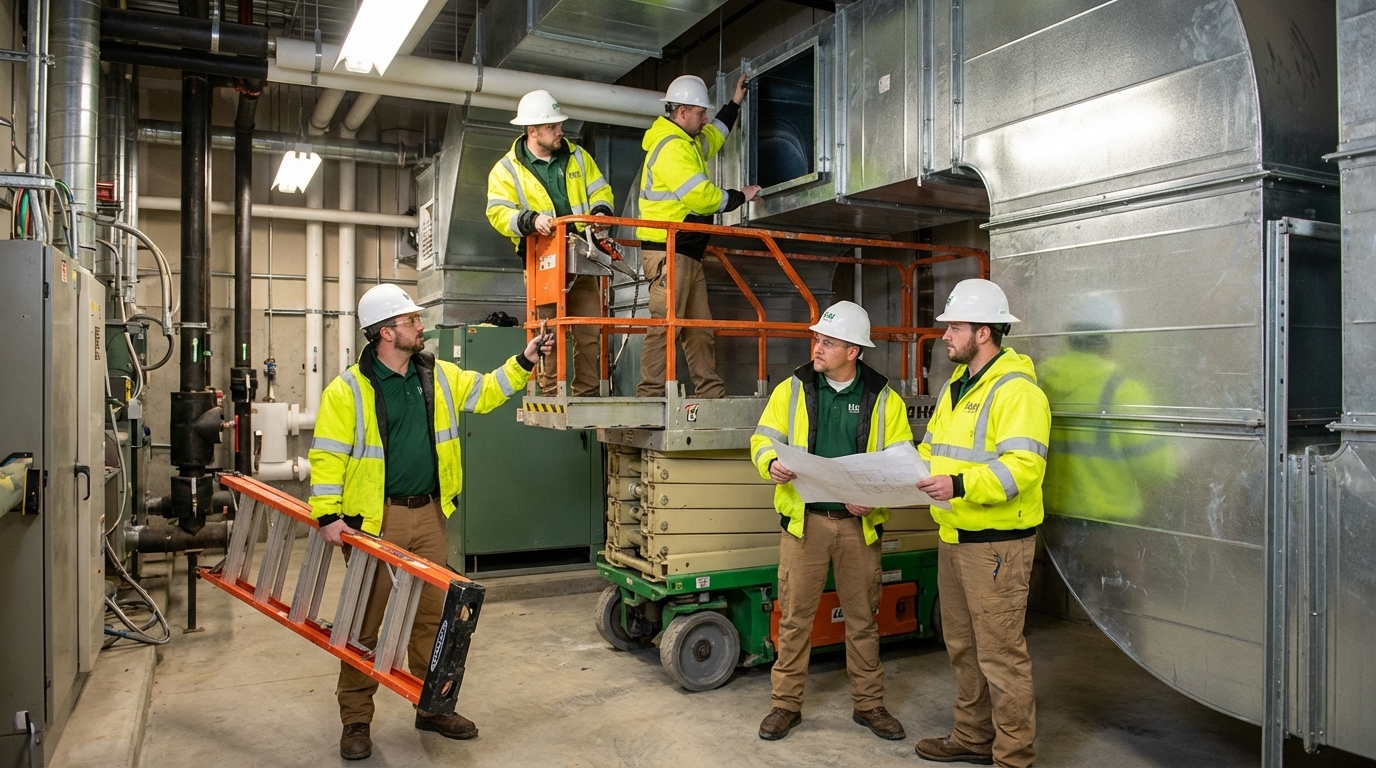
A low bid isn't always a good deal. When you're evaluating proposals, make sure you understand what's actually included. A complete, professional commercial HVAC installation should cover all of the following:
If a proposal is missing line items for commissioning, TAB, or closeout documentation, that's not a savings — that's a scope gap. Systems that aren't properly commissioned and balanced will underperform from day one, and you'll pay for it in energy costs and service calls.
Don't Forget the Controls: What BAS Adds to the Budget
Building Automation Systems are frequently treated as an optional upgrade. In our experience, that's the wrong way to think about it — especially for facilities over 10,000 sq ft with multiple HVAC zones.
A properly programmed BAS lets you:
- Monitor your entire facility's HVAC from any mobile device, anywhere in the world
- Receive real-time alarms before small problems become expensive failures
- Set occupancy schedules that stop conditioning empty spaces
- Track energy consumption and identify inefficiencies over time
- Integrate HVAC, lighting, and access control into a single platform
A BAS installation for a mid-size Wisconsin facility typically starts around $15,000 for a straightforward scope and scales from there depending on the number of integration points, the platform selected, and the complexity of programming required. For larger facilities with dozens of zones and multiple mechanical systems, the number can grow considerably — and so can the return.
Energy savings from a properly programmed BAS — through scheduling, setbacks, and optimization — typically range from 15–30% of HVAC operating costs. On a facility spending $40,000/year on HVAC energy, that's $6,000–$12,000 back annually. Most BAS investments pay for themselves within 3–5 years, and continue delivering savings for the life of the system.
H&H Mechanical is a Carrier partner with BACnet-certified technicians on staff. We also service Johnson Controls, Trane, Prolon, and other major BAS platforms — so we can recommend what's right for your building without being locked into a single vendor.
How to Get a Quote That's Actually Useful
A quote is only as good as the information behind it. When you reach out to a contractor — us or anyone else — the more context you can provide upfront, the more accurate and useful the number you get back will be.
Before you call, try to have a clear picture of:
- Building size and type — square footage, ceiling heights, and what the facility will be used for
- Project stage — new construction, existing building retrofit, or equipment replacement
- Current system — if replacing, what's there now and how old is it
- Zoning needs — how many separately controlled areas do you need
- Special requirements — process cooling, food-grade environments, 24/7 operation, high exhaust loads
- Timeline — when does the work need to be complete
One more thing worth saying directly: the cheapest bid is rarely the best value. In commercial HVAC, gaps in scope, undersized equipment, poor commissioning, and cut-rate ductwork will cost you far more over the life of the system than the difference between proposals. Ask your contractor what's included, what's excluded, and what happens if something changes.
Our goal on every project — from a single rooftop unit to a full design-build installation — is to deliver a system that runs right from day one and keeps running for decades.
Get a Quote Built Around Your Actual Scope
Tell us about your facility and what you're trying to accomplish. We'll respond with a clear plan, an honest range, and a timeline — no pressure, no runaround.